
Skip to content
CompFlow mark CompFlow
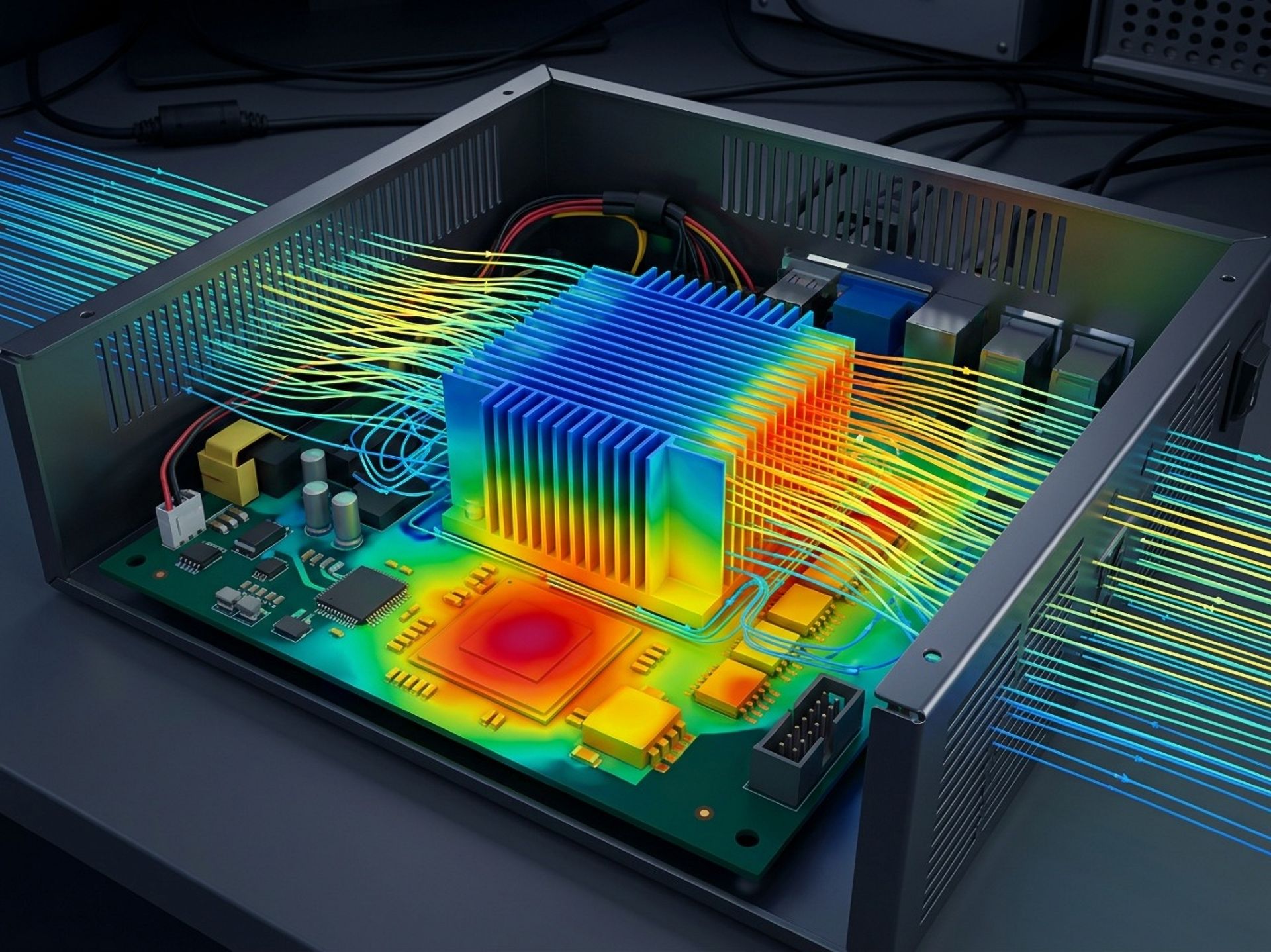
CFD thermal simulation of an electronics enclosure showing heat sink temperature contours and cooling airflow streamlines
SECTORS / 02 — ELECTRONICS COOLING

Thermal management for dense, quiet electronics.

Power density keeps climbing while enclosures shrink and acoustic limits tighten. We cover every aspect of cooling in electronics — thermal management, duct and fan optimisation, and the trade-off between airflow, noise and reliability.

BRIEF Read the ELECTRONICS COOLING sector brief
01 — SECTOR NEEDS

What this sector needs from CFD

Junction temperature drives component life, so the sector needs conjugate simulation that resolves solid conduction, board spreading and air movement together — early enough to influence enclosure and fan selection.

Conjugate heat transfer Solid conduction through dies, packages, PCB layers and heat sinks solved together with the surrounding air, not as separate estimates.
Low-velocity buoyancy Natural-convection and mixed-convection regimes where buoyancy competes with weak forced flow and standard wall treatments break down.
Fan and system curve matching Operating point prediction for axial and radial fans against real enclosure resistance, including recirculation and stall risk.
Acoustic trade-off Quantifying the noise cost of extra airflow so cooling capacity and sound power targets can be balanced deliberately.
Reliability margin Hotspot identification and derating margin under worst-case ambient, altitude and filter-blockage scenarios.
02 — REPRESENTATIVE CASES

Typical studies we run

06 CASE TYPES
01

Enclosure and rack airflow

Cabinet-level study of intake, exhaust and internal recirculation, identifying starved regions and short-circuit paths between hot and cold aisles.

Air temperature Flow rates Recirculation index
02

Heat sink optimisation

Fin geometry, pitch and base thickness optimised against pressure drop, weight and manufacturability for a given fan curve.

Thermal resistance ΔP Fin efficiency
03

PCB and component hotspots

Board-level conjugate model with detailed copper spreading, resolving junction and case temperatures for critical components.

Tj / Tcase Heat flux paths
04

Duct and fan integration

Duct routing, plenum design and fan placement to remove uneven loading, tonal noise and inlet distortion.

Operating point Velocity uniformity
05

Liquid and two-phase cooling

Cold plate, immersion and heat-pipe assisted designs for high-power devices where air cooling has run out of headroom.

Coolant ΔT Pumping power
06

Sealed and outdoor enclosures

IP-rated sealed housings relying on conduction and external convection, including solar gain and altitude derating.

Surface temperature Derating curves
03 — POLICY & COMPLIANCE

Requirements verifiable through CFD

Simulation supports — and in several frameworks explicitly permits — demonstration of compliance. We agree the acceptance criteria and validation evidence with you and the approving body before the study begins.

IEC 62368-1
Safety of audio/video and IT equipment
Temperature limits for touchable surfaces, insulation and components can be pre-screened by simulation before the formal heating test, reducing failed test iterations.
JEDEC JESD51 series
Thermal test and modelling standards
Defines the thermal metrics and boundary conditions (θJA, ΨJT, JEDEC test board) that a defensible electronics thermal model must reproduce.
IEC 60529 (IP ratings)
Ingress protection versus cooling
Sealing requirements remove ventilation options; simulation demonstrates that a compliant sealed design still meets temperature limits.
ISO 3744 / ISO 7779
Declared noise emission
Flow-generated and fan noise contributions can be assessed against declared sound-power values while airflow targets are held.
ETSI EN 300 019 / GR-63-CORE
Telecom equipment environments
Ambient, altitude and thermal-shock envelopes for telecom sites define the worst-case scenarios a thermal study must cover.

Fighting a thermal limit inside a fixed enclosure?

Discuss your case See our services