
Skip to content
CompFlow mark CompFlow
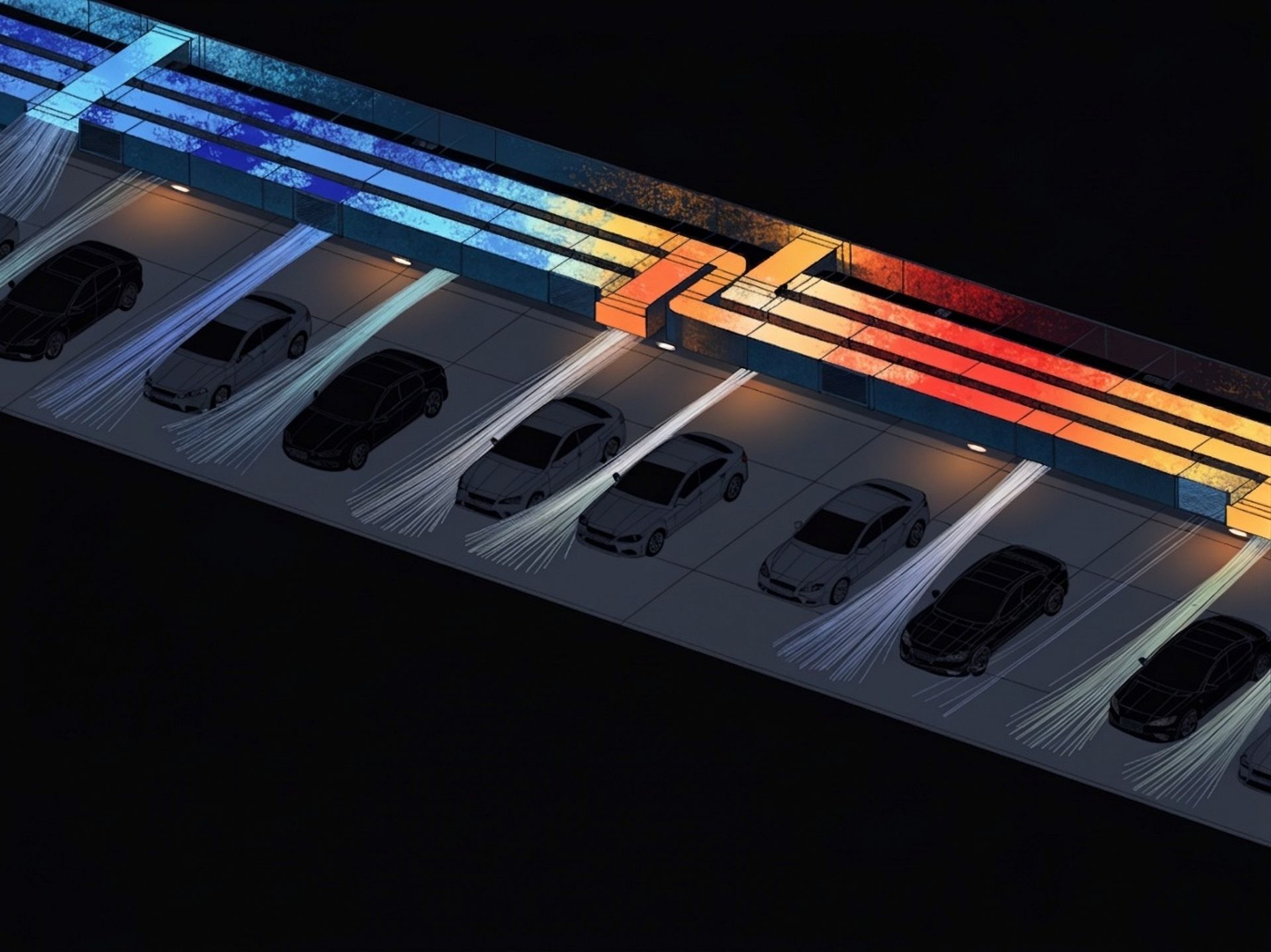
CFD ventilation study of a car park showing supply air streamlines and duct temperature contours
SECTORS / 05 — HVAC STUDIES

Comfort, air quality and energy in one balance.

From automotive cabins to civil engineering and large structures, HVAC studies decide whether occupants are comfortable and whether the energy budget holds. We resolve the airflow that spreadsheet load calculations cannot see.

BRIEF Read the HVAC STUDIES sector brief
01 — SECTOR NEEDS

What this sector needs from CFD

Comfort complaints and energy overruns usually come from local airflow behaviour, so the sector needs simulation that predicts draught, stratification and contaminant transport at occupant scale.

Local thermal comfort Predicted mean vote, draught rate and vertical temperature gradients at occupied positions rather than a single room average.
Ventilation effectiveness Age of air, contaminant removal effectiveness and short-circuiting between supply and extract — the real measure of whether fresh air reaches people.
Stratification in tall spaces Displacement and buoyancy-driven behaviour in atria, halls and industrial volumes where mixing assumptions collapse.
Diffuser and terminal selection Throw, spread and entrainment behaviour of real terminal devices, including interaction between adjacent units.
Energy and load reduction Quantifying the saving from setpoint, flow-rate or system-type changes without giving up compliance margins.
02 — REPRESENTATIVE CASES

Typical studies we run

06 CASE TYPES
01

Office and open-plan comfort

Diffuser layout, supply temperature and flow rates assessed for draught risk and uniformity across the occupied zone.

PMV / PPD Draught rate Air velocity
02

Automotive cabin HVAC

Cabin airflow, defrost and demist performance including solar load, occupant plumes and duct pressure losses.

Face-level temp Defrost time Duct ΔP
03

Cleanroom and operating theatre

Unidirectional flow integrity, recovery time and particle transport around equipment and staff for classified spaces.

Particle counts Recovery time Flow visualisation
04

Data centre air management

Aisle containment, CRAC placement and leakage assessed for inlet temperature compliance and PUE improvement.

Inlet temperature Bypass ratio
05

Industrial and kitchen ventilation

Capture efficiency of hoods and local extract for heat, fumes and moisture, including make-up air interaction.

Capture efficiency Contaminant levels
06

Infection control and dilution

Airborne contaminant dispersion between occupants, and the effect of ventilation rate, filtration and layout on exposure.

Exposure index Air changes/hour
03 — POLICY & COMPLIANCE

Requirements verifiable through CFD

Simulation supports — and in several frameworks explicitly permits — demonstration of compliance. We agree the acceptance criteria and validation evidence with you and the approving body before the study begins.

ISO 7730 / EN 16798-1
Thermal comfort and indoor environment
PMV/PPD, draught rate and local discomfort indices are computed directly from simulation results and compared with the category limits the project targets.
ASHRAE 55
Thermal environmental conditions
Occupied-zone comfort criteria — including air speed and vertical gradient limits — verified at real occupant positions.
ASHRAE 62.1 / EN 16798-3
Ventilation for acceptable indoor air quality
Ventilation effectiveness assumptions behind required outdoor air rates can be substantiated rather than taken from default tables.
ISO 14644-3
Cleanroom test methods
Recovery, airflow visualisation and containment leak behaviour can be pre-assessed by simulation before qualification testing.
EPBD (EU 2024/1275)
Energy performance of buildings
Airflow-driven energy measures modelled to support the performance calculations and indoor-climate reporting the directive requires.

Comfort or air-quality target you need to prove?

Discuss your case See our services