
Skip to content
CompFlow mark CompFlow
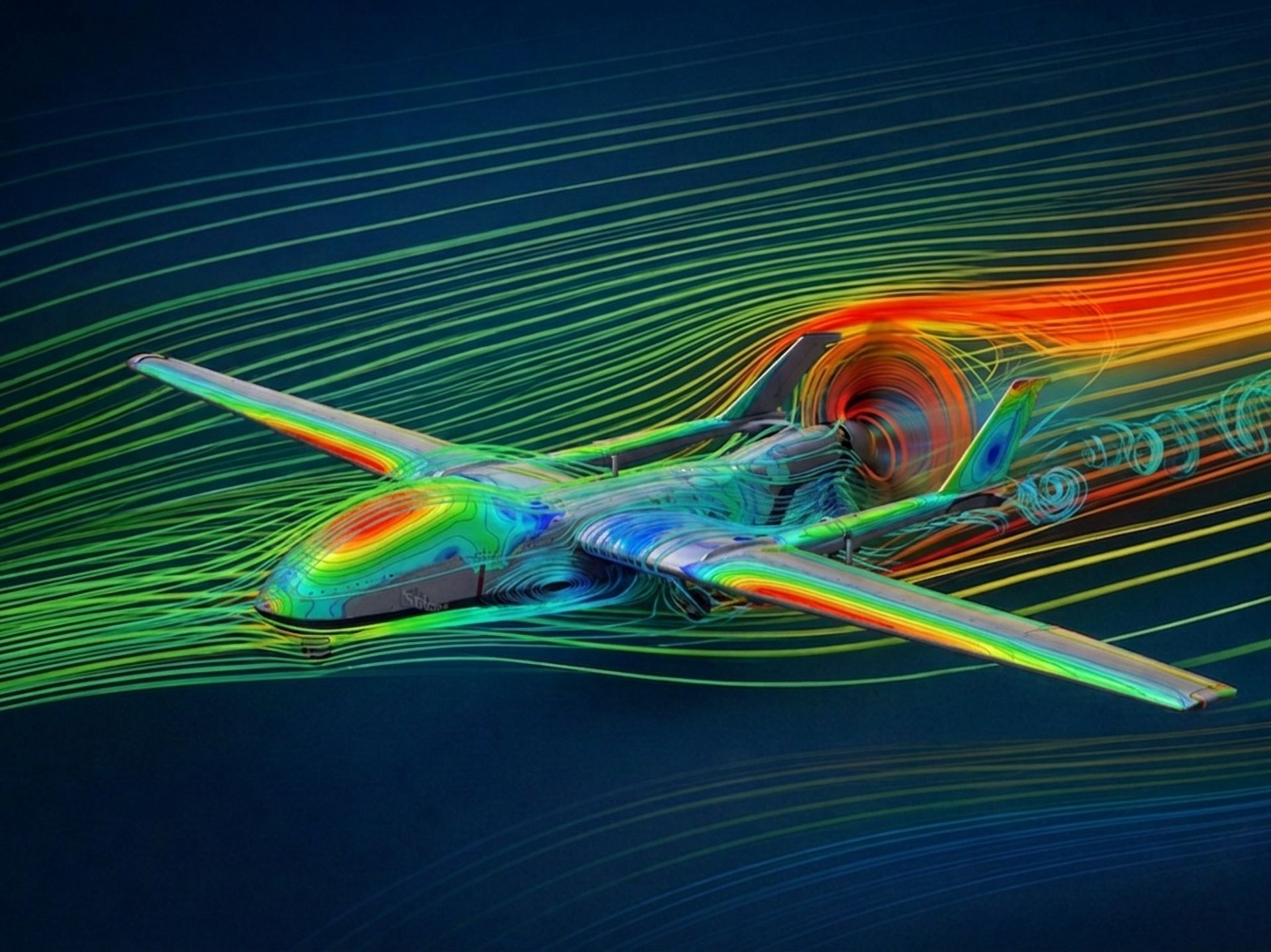
CFD simulation of an aircraft showing surface pressure contours and coloured airflow streamlines
SECTORS / 01 — AERODYNAMICS

External flows, drag and heat transfer at speed.

From automotive and motorsport to aerospace and flight-related flows, aerodynamic performance decides fuel burn, stability and homologation outcomes. Our portfolio covers external flows and the heat transfer that comes with them.

BRIEF Read the AERODYNAMICS sector brief
01 — SECTOR NEEDS

What this sector needs from CFD

Aerodynamic development is iteration-limited: tunnel time and prototypes are scarce, so the sector needs simulation that resolves separated, unsteady flow accurately enough to rank design candidates before anything is built.

Drag and lift accuracy Force and moment coefficients resolved consistently enough that small deltas between design candidates are trustworthy, not numerical noise.
Unsteady separation Wake structures, vortex shedding and separation onset need scale-resolving turbulence treatment (DES/LES) rather than steady RANS alone.
Thermal coupling Brake, powertrain and battery cooling depend on conjugate heat transfer through ducts, exchangers and porous media.
Ground and rotation effects Moving ground planes, rotating wheels and propellers must be modelled to reproduce on-road or in-flight conditions.
Tunnel correlation Blockage, support interference and boundary-layer differences must be reconciled so simulation and experiment can be compared honestly.
02 — REPRESENTATIVE CASES

Typical studies we run

06 CASE TYPES
01

Vehicle external aerodynamics

Full-vehicle drag and lift breakdown with moving ground and rotating wheels, isolating the contribution of each body region to the overall balance.

Cd / Cl Pressure maps Wake surveys
02

Motorsport downforce devices

Wing, diffuser and floor optimisation across ride heights and yaw angles, including sensitivity to regulatory box constraints.

Downforce maps Aero balance Ride-height sweeps
03

Cooling package and brake ducts

Coupled internal-external study of radiator, condenser and brake cooling flows, resolving exchanger pressure drop and component temperatures.

Mass flow Duct ΔP Wall temperatures
04

Airfoil and wing performance

Polar generation across Reynolds and Mach ranges, including stall onset, transition sensitivity and high-lift device behaviour.

Lift polars Stall margin Transition location
05

Store and airframe interference

Interaction between fuselage, nacelles, rotors and external stores, including installed thrust and interference drag.

Interference drag Load distribution
06

Aeroacoustic source identification

Scale-resolving simulation to locate dominant noise sources and rank mitigation options before physical prototyping.

Source maps Spectra Surface pressure
03 — POLICY & COMPLIANCE

Requirements verifiable through CFD

Simulation supports — and in several frameworks explicitly permits — demonstration of compliance. We agree the acceptance criteria and validation evidence with you and the approving body before the study begins.

EU 2017/1151 (WLTP)
Road-load and CO₂ determination
Aerodynamic drag is a direct input to road-load and emissions figures; CFD supports coastdown and wind-tunnel correlation and pre-screens configuration variants before the certification campaign.
UN ECE R51.03
Vehicle noise limits
Aeroacoustic simulation identifies flow-generated noise sources and quantifies the effect of mitigation, complementing pass-by measurement.
CS-25 / FAR 25
Large aeroplane airworthiness
Performance and handling substantiation is increasingly supported by validated CFD alongside flight and tunnel test, subject to agreed validation evidence with the authority.
FIA technical regulations
Bodywork and aero legality
Simulation verifies that aerodynamic devices remain inside the legality boxes and deflection limits while performance is optimised.

Ranking aerodynamic candidates before the next tunnel slot?

Discuss your case See our services