
Skip to content
CompFlow mark CompFlow
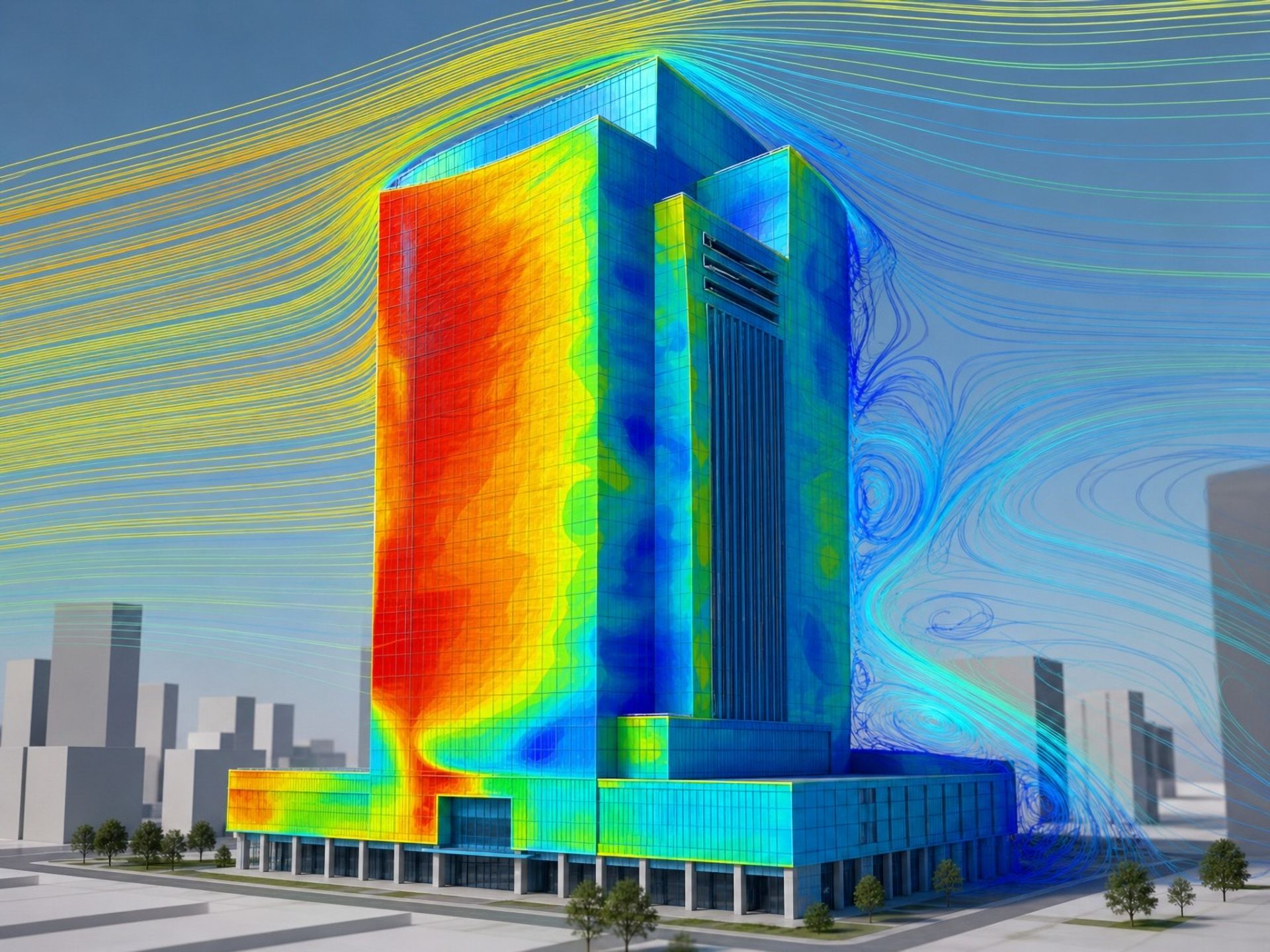
CFD wind load simulation of a high-rise building showing facade pressure contours and wake streamlines
SECTORS / 07 — CIVIL CONSTRUCTIONS

Wind around buildings, and the flows inside them.

Flows around buildings and internal building flows, with support at every stage of construction. Planning authorities increasingly ask for quantified wind, comfort and dispersion evidence before consent is granted.

BRIEF Read the CIVIL CONSTRUCTIONS sector brief
01 — SECTOR NEEDS

What this sector needs from CFD

Urban wind behaviour is site-specific and cannot be read from code tables alone, so the sector needs simulation of the real surroundings — with the terrain, neighbours and wind statistics of the actual location.

Pedestrian wind comfort Wind speeds at entrances, terraces and thoroughfares combined with local wind statistics to give exceedance frequencies, not just single-case velocities.
Cladding and structural loads Peak and mean pressure coefficients on facades, roofs and canopies, particularly for shapes outside code coverage.
Interference from neighbours Channelling, downwash and shielding caused by surrounding buildings, including future consented developments.
Pollutant and odour dispersion Exhaust, plant and traffic emissions re-entering intakes, balconies and neighbouring windows.
Internal environment Natural ventilation potential, atrium stratification and stack effect for the building as it will actually be operated.
02 — REPRESENTATIVE CASES

Typical studies we run

06 CASE TYPES
01

Pedestrian wind microclimate

Full wind-rose assessment at ground level and on terraces, with mitigation such as screens, canopies and planting tested iteratively.

Comfort categories Exceedance hours Gust factors
02

Facade wind loading

Pressure coefficient distributions for cladding zones and unusual geometries where code figures do not apply.

Cp maps Peak pressures Zone loads
03

Natural and mixed-mode ventilation

Wind and buoyancy-driven ventilation potential through openings, atria and shafts across seasonal conditions.

Air change rates Opening flows
04

Plant and traffic dispersion

Dispersion from generator, kitchen and laboratory exhausts, or nearby roads, into intakes and occupied outdoor space.

Concentration maps Intake dilution
05

Stadium and canopy flows

Wind comfort in seating bowls, pitch ventilation and turf health, plus load on large lightweight roofs.

Spectator comfort Roof loads
06

Bridge and slender structure aerodynamics

Vortex shedding, galloping and buffeting risk for decks, towers, masts and long-span elements.

Strouhal number Force coefficients
03 — POLICY & COMPLIANCE

Requirements verifiable through CFD

Simulation supports — and in several frameworks explicitly permits — demonstration of compliance. We agree the acceptance criteria and validation evidence with you and the approving body before the study begins.

EN 1991-1-4 (Eurocode 1)
Wind actions on structures
Permits wind-tunnel testing and appropriate numerical methods where code coefficients do not cover the geometry, with pressure coefficients derived from the study.
NEN 8100
Wind comfort and wind danger criteria
The widely used framework for exceedance-based comfort classification, computed from CFD combined with local meteorological statistics.
City of London wind guidelines
Wind microclimate assessment
Typical of planning authorities now requiring quantified pedestrian comfort and safety evidence as a condition of consent.
VDI 3783 / COST 732
Environmental dispersion modelling quality
Best-practice guidance for urban dispersion and for the validation evidence expected alongside CFD results.
ASCE 49
Wind tunnel testing for buildings
Defines simulation-of-atmospheric-flow requirements that a defensible numerical study should also satisfy.

Planning submission that needs wind evidence?

Discuss your case See our services