
Skip to content
CompFlow mark CompFlow
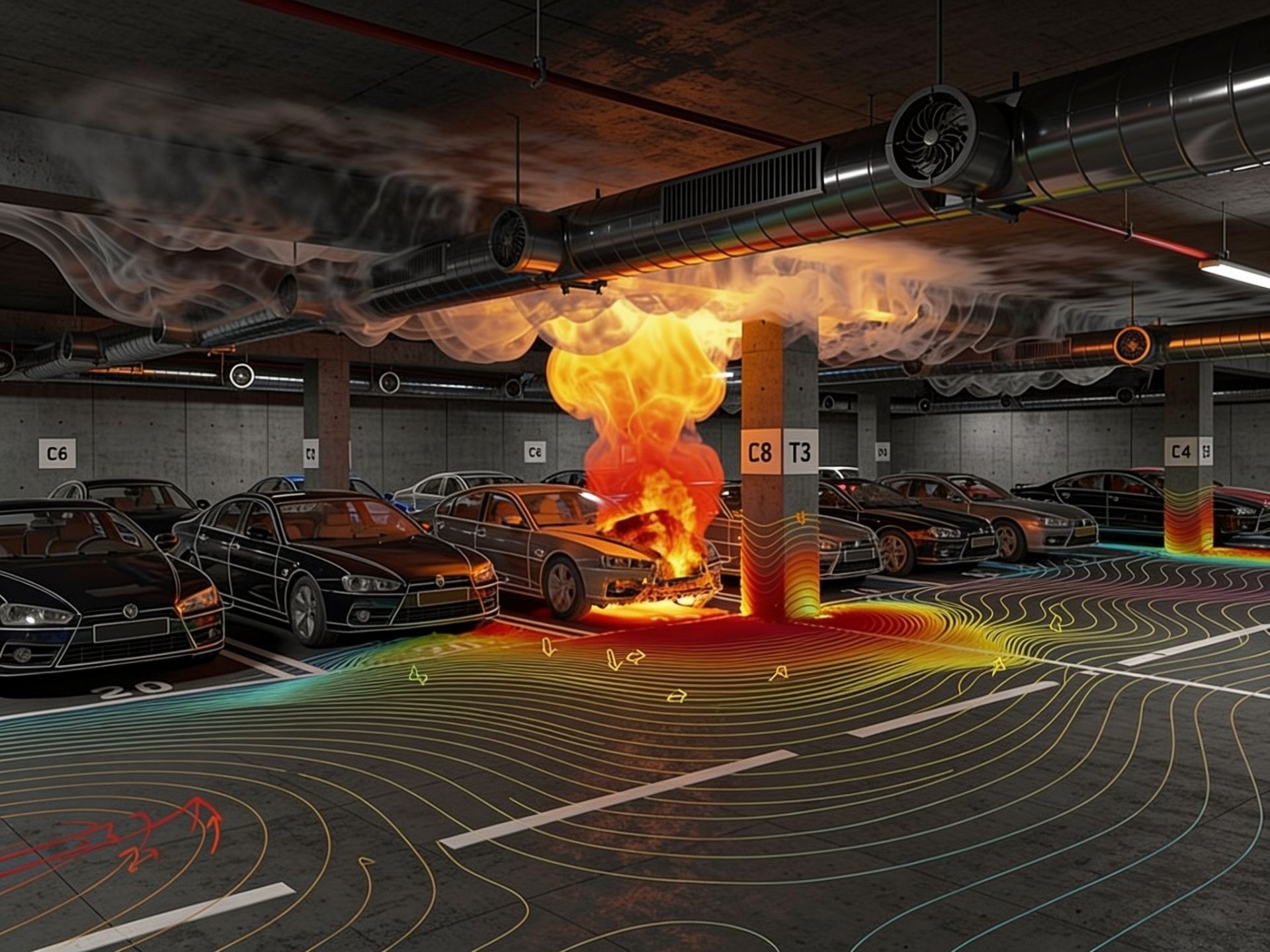
CFD fire and smoke propagation simulation of a car fire in an underground car park with ventilation ducts and temperature contours
SECTORS / 04 — FIRE PROPAGATION

Smoke control and evacuation, evidenced by simulation.

Smoke ventilation, fire propagation and evacuation studies using robust, novel simulation methods. These studies underpin performance-based fire strategies where prescriptive rules cannot deliver the architecture the client wants.

BRIEF Read the FIRE PROPAGATION sector brief
01 — SECTOR NEEDS

What this sector needs from CFD

Life-safety arguments hinge on tenability over time, so the sector needs coupled fire, smoke and occupant modelling with conservative assumptions the approving authority will accept.

Tenability over time Visibility, temperature, radiant flux and toxic species tracked along escape routes for the full evacuation duration, not just at steady state.
Design fire justification Heat release rate curves, growth rates and fuel packages selected and defended from recognised data rather than assumed.
Smoke control performance Extract rates, make-up air, plug-holing risk and clear-layer height demonstrated for the critical fire locations.
Coupled evacuation Occupant movement modelled alongside smoke spread so available and required safe egress times can be compared directly.
Sprinkler and detection interaction Activation timing and the effect of suppression on plume behaviour, including sprinkler-smoke interaction in tall spaces.
02 — REPRESENTATIVE CASES

Typical studies we run

06 CASE TYPES
01

Atrium and mall smoke control

Large-volume smoke reservoir design, extract sizing and clear-layer maintenance for open connected spaces and voids.

Layer height Visibility Extract rate
02

Car park ventilation

Jet-fan and ducted systems assessed for smoke clearance and for firefighting access conditions in basement and enclosed parks.

Visibility Temperature Backlayering
03

Tunnel and metro fire

Longitudinal and semi-transverse ventilation, critical velocity and backlayering control for road, rail and station fires.

Critical velocity Tenability CO levels
04

Stair and lobby pressurisation

Pressure differential systems verified against door-opening scenarios, leakage assumptions and stack effect in tall buildings.

Pressure ΔP Door forces Air velocity
05

Facade and external spread

External flame spread over facades, balconies and cavities, including re-entry through openings on upper floors.

Flame extent Heat flux
06

Coupled evacuation analysis

Occupant egress simulation combined with smoke results to compare ASET and RSET with a defensible safety margin.

ASET / RSET Queue times
03 — POLICY & COMPLIANCE

Requirements verifiable through CFD

Simulation supports — and in several frameworks explicitly permits — demonstration of compliance. We agree the acceptance criteria and validation evidence with you and the approving body before the study begins.

EN 12101 series
Smoke and heat control systems
Performance of natural and powered smoke ventilators, and of pressure differential systems, can be demonstrated by simulation where standard sizing rules do not apply.
EN 1991-1-2 (Eurocode 1)
Actions on structures exposed to fire
Permits natural fire models — including CFD-derived gas temperatures — as an alternative to nominal curves for structural fire design.
BS 7974 / PD 7974
Application of fire safety engineering
The framework and sub-system guidance our reports follow for design fires, smoke movement and tenability criteria.
NFPA 92 / NFPA 204
Smoke control and smoke/heat venting
Defines design objectives, tenability criteria and modelling documentation expectations for smoke management systems.
NFPA 130
Fixed guideway transit and passenger rail
Station and tunnel emergency ventilation criteria, including the six-minute egress objective, verified with coupled smoke and evacuation modelling.

Building a performance-based fire strategy?

Discuss your case See our services