
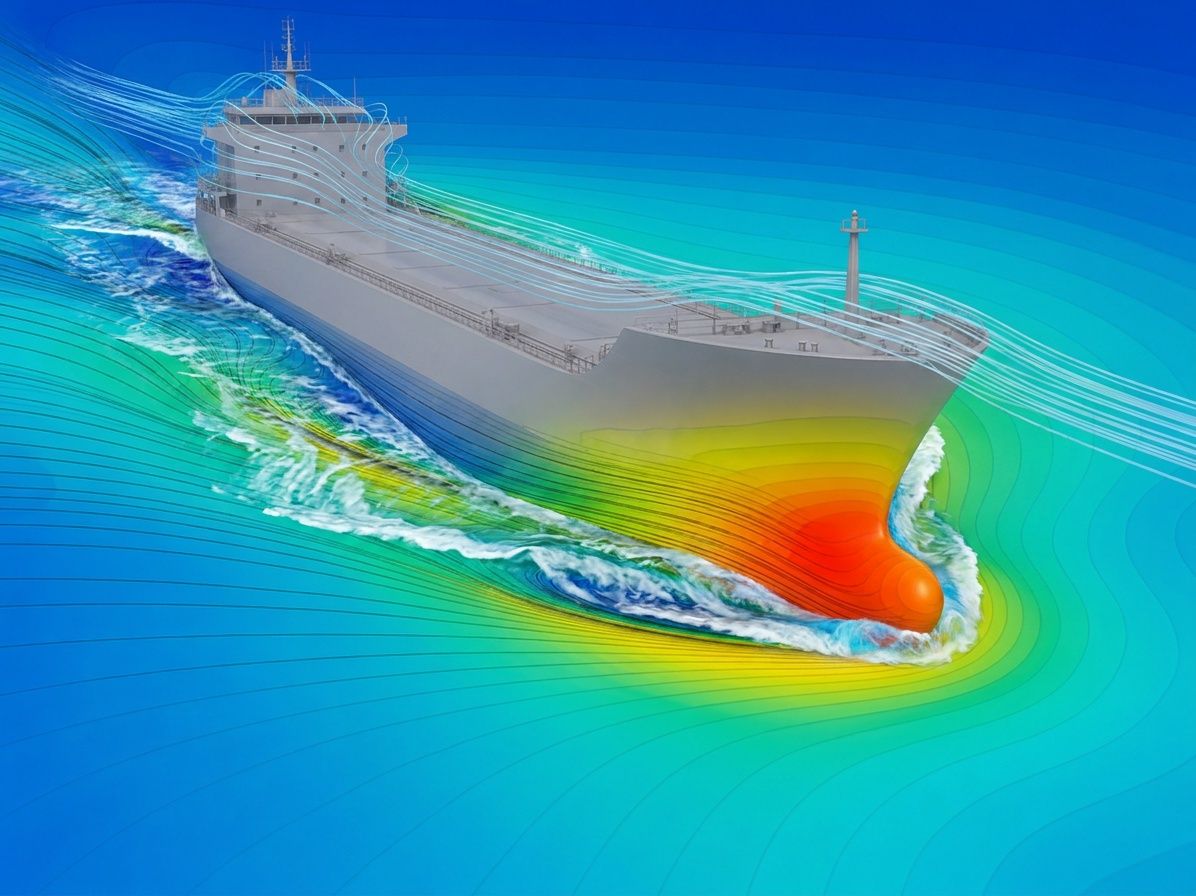
What this sector needs from CFD
Every percent of resistance shows up in fuel and in efficiency indices, so the sector needs free-surface simulation trustworthy enough to guide hull and propulsor decisions between model tests.
Typical studies we run
Hull resistance and trim optimisation
Calm-water resistance across the speed range with sinkage and trim free, ranking hull form and appendage variants.
Energy saving devices
Ducts, fins and pre-swirl stators assessed for real gain behind the hull rather than in isolation.
Propeller and cavitation study
Behind-hull propeller loading and cavitation extent, with pressure pulses transmitted to the hull structure.
Appendage and rudder interaction
Rudder, shaft bracket and bilge keel flow, including gap cavitation and manoeuvring side force.
Superstructure wind loads
Wind resistance and load coefficients for hulls, deck cargo and offshore topsides across heading angles.
Exhaust and helideck flow
Funnel plume dispersion, downwash onto decks, and helideck turbulence and temperature-rise criteria.
Requirements verifiable through CFD
Simulation supports — and in several frameworks explicitly permits — demonstration of compliance. We agree the acceptance criteria and validation evidence with you and the approving body before the study begins.